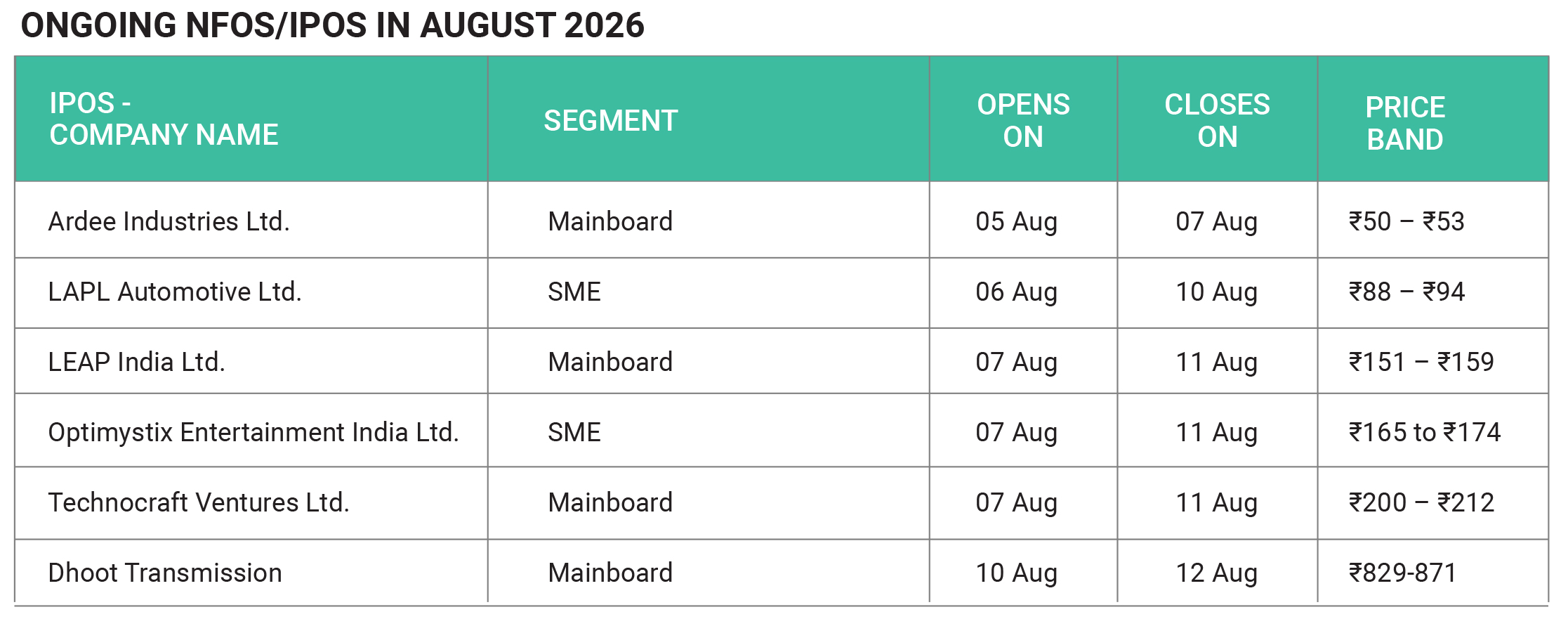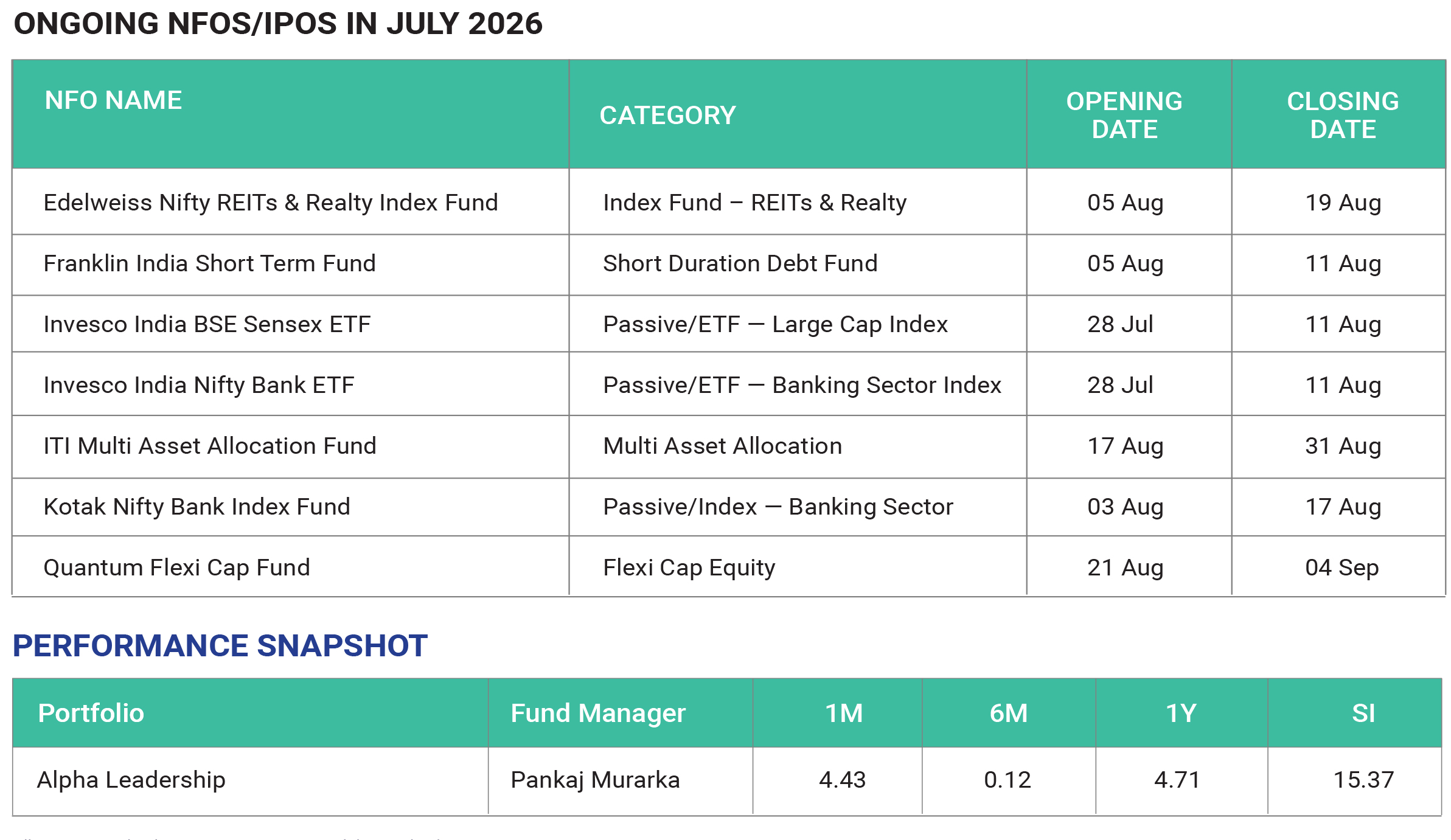
July 2026 was another positive month for Indian equity markets, with both the BSE Sensex and NSE Nifty 50 extending their gains despite experiencing considerable volatility. The month was characterized by a sharp correction during the first half, followed by a strong recovery in the latter weeks, allowing both benchmark indices to finish higher. The Nifty 50 ended the month at 24,383.60, gaining approximately 2.2%, while the Sensex closed at 78,094.64, up around 2.1%, after briefly touching an intraday high of 78,664.92. This marked the first consecutive monthly gain for both indices in 2026 and reinforced the resilience of Indian equities despite persistent geopolitical tensions, fluctuating crude oil prices, and uncertain global economic conditions. During the month, the total market capitalization of BSE-listed companies increased by nearly ₹12 trillion, reaching approximately ₹486 trillion, while Indian markets outperformed most major Asian indices as well as the S&P 500 and Nasdaq.
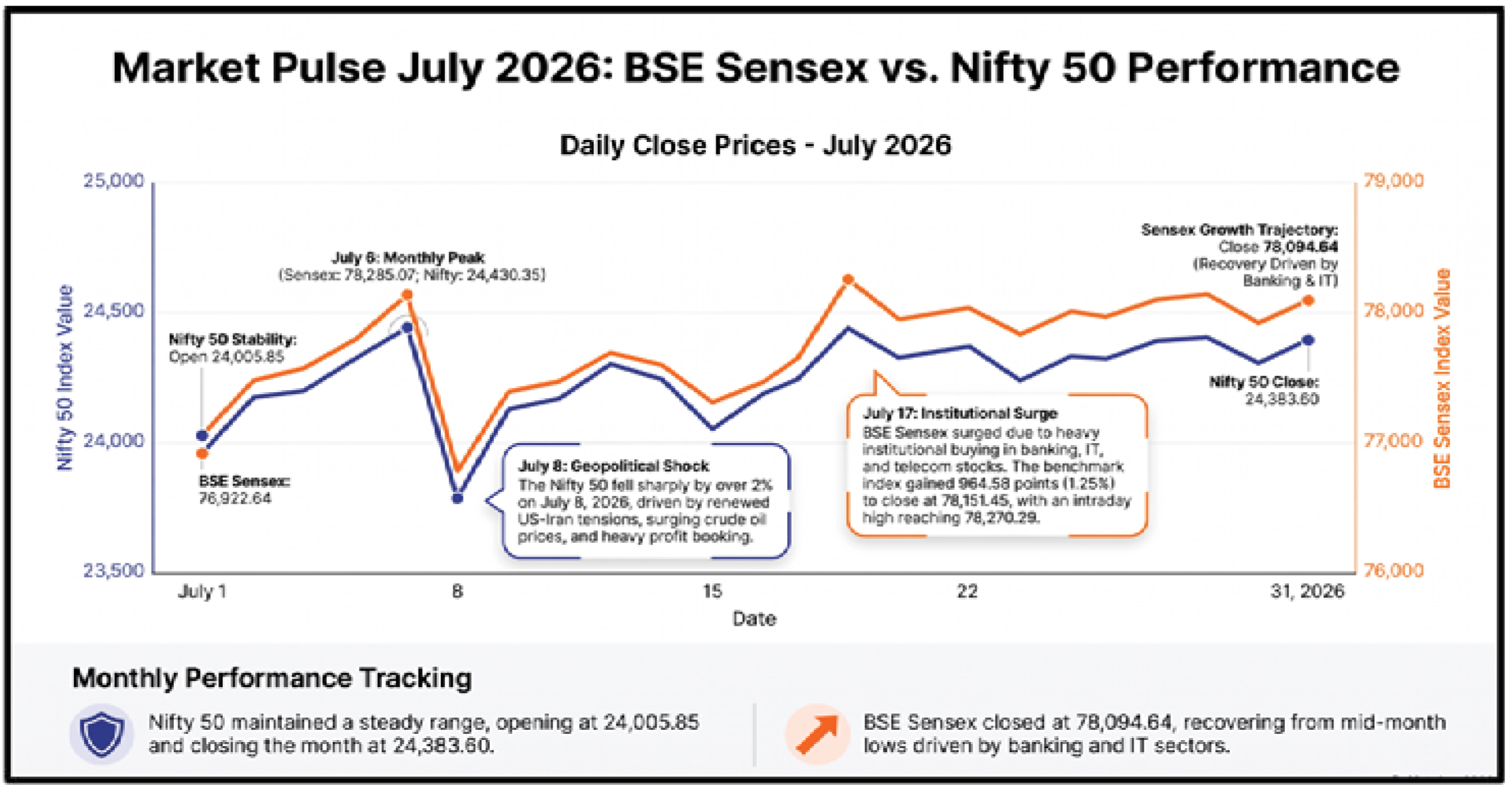
The journey to these gains, however, was far from smooth. The month began on a relatively stable note, with the Nifty closing the week ending July 3 at 24,270.85. Sentiment deteriorated rapidly over the following days as investors turned cautious amid escalating geopolitical tensions in the Middle East, rising crude oil prices, and increased global market volatility. The Nifty declined sharply to around 23,882 by July 8, while the Sensex also registered a steep fall, reflecting widespread profit booking after the previous rally. Concerns over persistent inflation, uncertainty regarding global interest rates, and foreign institutional investor (FII) selling added further pressure. The situation intensified between July 6 and July 13 as renewed attacks on shipping routes, military strikes involving Iran, and missile exchanges increased fears of disruptions to global oil supplies. On July 13, the Sensex recorded one of its sharpest intraday declines of the month, falling more than 700 points as investors reacted to heightened geopolitical risks. As the month progressed, market sentiment gradually improved despite the conflict remaining unresolved. Investors became increasingly accustomed to geopolitical headlines, shifting their focus toward corporate earnings and domestic economic fundamentals. Better-than-expected quarterly results from several large companies, particularly private sector banks and leading information technology firms, encouraged investors to return to equities. Strong earnings reaffirmed confidence in corporate profitability and supported buying during market declines. Financial stocks, automobiles, and several heavyweight companies led the rebound, while selective IT companies delivered encouraging earnings that revived interest in the technology sector. Although a few large corporations issued cautious guidance that occasionally triggered intraday volatility, the overall earnings season remained sufficiently positive to improve investor confidence. Foreign investor activity played a decisive role in the market's recovery. After remaining net sellers for several consecutive months, foreign portfolio investors (FPIs) returned as net buyers during July, investing over ₹15,000 crore, with some estimates placing total inflows above ₹20,000 crore when primary market investments were included. This reversal marked a significant change after substantial outflows recorded between March and June and reflected improving confidence in India's economic outlook relative to other emerging markets. The return of foreign capital provided liquidity to large-cap stocks and helped offset concerns arising from global uncertainty. At the same time, strong domestic participation through systematic investment plans (SIPs), sustained retail investor interest, and continued inflows into mutual funds provided an additional cushion whenever markets corrected. The information technology sector emerged as the month's standout performer. A global sell-off in artificial intelligence-related stocks prompted international investors to rotate capital toward relatively stable Indian IT companies, resulting in a remarkable rally. The Nifty IT index surged nearly 17%, recording its strongest monthly performance since July 2020. The rally was further supported after the US Federal Reserve kept interest rates unchanged at its July policy meeting, easing concerns about tighter global financial conditions and encouraging continued investment into export-oriented technology companies. Apart from IT, several domestic sectors also posted healthy gains. Consumer durables, real estate, and automobile stocks benefited from expectations of improving consumer demand, lower input costs as crude oil softened later in the month, and optimism surrounding the broader economic outlook. Macroeconomic developments continued to influence investor sentiment throughout July. Rising crude oil prices during periods of heightened Middle East tensions weighed on markets because India remains heavily dependent on imported energy, making higher oil prices a risk for inflation, corporate margins, and the fiscal balance. Brent crude experienced sharp swings, at one point climbing close to $88 per barrel amid renewed conflict before easing later in the month. The subsequent moderation in crude prices reduced inflation concerns and supported the market recovery. Investors also monitored domestic inflation data and wholesale price trends closely, as these influenced expectations regarding the Reserve Bank of India's future monetary policy decisions and bond yields. A relatively stable rupee, combined with softer commodity prices toward the end of the month, further strengthened investor confidence. Although benchmark indices recorded healthy monthly gains, the underlying market breadth remained relatively narrow. Large-cap stocks, particularly within the IT sector, accounted for a significant share of the rally, while many mid- and small-cap stocks struggled to keep pace. The Nifty 50, Nifty Midcap 100, Nifty Smallcap 100, and Nifty 500 indices all posted gains ranging between roughly 1.5% and 2%, demonstrating broad resilience across market segments. However, on the BSE, while the Sensex, BSE 500, and Midcap indices advanced, the Smallcap index ended marginally lower. More than half of the BSE 500 constituents underperformed the benchmark, and nearly 280 stocks declined during the month, highlighting that investor participation remained concentrated in select large-cap companies rather than being uniformly distributed across the market. Overall, July 2026 demonstrated the resilience of Indian equity markets in navigating multiple external and domestic challenges. Despite geopolitical conflicts, volatile crude oil prices, inflation concerns, and periods of foreign selling, markets recovered strongly on the back of robust corporate earnings, renewed foreign investment, resilient domestic liquidity, and improving global risk appetite. The strong performance of the IT sector, combined with healthy participation from financials and consumer-focused sectors, helped Indian benchmarks outperform several global peers. By the end of the month, investors had largely looked beyond short-term geopolitical disruptions and refocused on India's long-term growth prospects, enabling both the Sensex and Nifty to record another month of positive returns while reinforcing confidence in the market's underlying strength.
India's debt market delivered a resilient performance in July 2026, supported by strong foreign capital inflows, ample liquidity, and a stable monetary policy backdrop, although gains moderated during the second half of the month as global risks resurfaced. Government bond yields declined to their lowest levels in nearly four months during early July, reflecting optimism following the strong rally witnessed in June. However, the market later entered a consolidation phase as rising crude oil prices, firmer US Treasury yields, and geopolitical tensions in the Middle East prompted investors to adopt a more cautious stance. Overall, July was characterized by a bullish start followed by range-bound trading, with the debt market remaining significantly more resilient than many analysts had anticipated despite heightened global uncertainty. Government securities (G-Secs) remained the primary focus throughout the month. The benchmark 10-year government bond yield fell to around 6.68% in early July, nearly 46 basis points below the peak of approximately 7.14% recorded in April, as investors continued to benefit from declining inflation expectations and improving demand for sovereign debt. As the month progressed, yields gradually moved higher, ending July close to 6.81%, while the 30-year government bond yield also edged upward. The increase was largely driven by a temporary spike in Brent crude oil prices, stronger US Treasury yields, and regular government borrowing through weekly bond auctions. Nevertheless, bond yields remained well below the highs seen earlier in the year, highlighting the market's ability to absorb external shocks without experiencing a significant sell-off. A notable feature of July was the Indian bond market's resilience in the face of renewed geopolitical tensions. Escalating conflict in West Asia briefly pushed Brent crude above $90 per barrel, a development that would typically have triggered a sharp rise in Indian bond yields due to concerns over imported inflation and fiscal pressures. Instead, yields remained relatively stable, reflecting the strength of domestic and foreign demand for Indian government securities. This resilience was driven less by improving macroeconomic fundamentals and more by a series of policy reforms introduced in recent months. The Reserve Bank of India expanded the Fully Accessible Route (FAR) to include additional long-term government securities, removed several investment restrictions for foreign investors, and introduced liquidity-enhancing measures. Simultaneously, the government abolished capital gains and withholding taxes on eligible foreign investments in government securities, significantly improving the attractiveness of Indian debt for overseas investors. Foreign portfolio investment emerged as the strongest supporting factor for the debt market. Record inflows into government securities under the Fully Accessible Route during June carried over into July, providing sustained demand that helped absorb heavy sovereign debt issuance. Investor optimism was further reinforced by expectations that India would eventually be included in the Bloomberg Global Aggregate Bond Index, an event that could attract substantial passive global investment into Indian debt markets. These structural reforms and anticipated index-related inflows outweighed the negative impact of elevated crude oil prices and tighter global financial conditions, allowing Indian bonds to outperform many emerging market peers. As a result, the yield spread between Indian and US 10-year government bonds narrowed considerably during the month, highlighting the growing influence of India-specific policy reforms over external risk factors. Other segments of the debt market broadly mirrored developments in government securities. State Development Loans (SDLs) generally tracked movements in sovereign bonds, although frequent auction supply and borrowing requirements occasionally placed upward pressure on yields. Corporate bond issuance remained robust throughout July, particularly through private placements, indicating healthy investor appetite and continued access to funding for high-quality issuers. Stable government bond yields also helped contain corporate borrowing costs, although lower-rated issuers continued to face relatively wider credit spreads due to cautious investor sentiment and liquidity preferences. Meanwhile, short-term money market rates remained well supported by comfortable banking system liquidity and expectations that the Reserve Bank of India would maintain its policy pause. Long-duration bonds performed particularly well during the first half of the month but became more volatile later as global bond yields and crude oil prices strengthened. The broader macroeconomic environment presented both supportive and challenging influences. The Reserve Bank of India maintained the repo rate at 5.25% with a neutral policy stance, providing stability to fixed-income markets ahead of the next monetary policy review in early August. Investors closely monitored inflation trends, monsoon progress, and energy prices, all of which carried implications for future policy decisions. Encouragingly, cumulative monsoon rainfall improved considerably during July, reducing concerns over food inflation and supporting expectations that inflationary pressures could remain manageable. At the same time, a relatively stable rupee helped limit imported inflation despite periodic volatility in global commodity prices. However, rising US Treasury yields and the US Federal Reserve's relatively hawkish tone continued to limit the scope for a sustained decline in Indian bond yields. Overall, July 2026 demonstrated the growing resilience of India's debt market to global shocks. While crude oil volatility, geopolitical tensions, and higher global bond yields created intermittent pressure, these headwinds were largely offset by regulatory reforms, strong foreign investment, abundant liquidity, and stable monetary policy expectations. Importantly, the month's rally appeared to be driven more by technical and policy-related factors than by a significant improvement in underlying economic fundamentals. Analysts therefore cautioned that the favourable environment remained dependent on continued foreign inflows, progress toward global bond index inclusion, stable geopolitical conditions, and supportive domestic macroeconomic trends. Even so, July reinforced India's position as an increasingly attractive destination for global fixed-income investors and highlighted the strengthening structural foundations of its sovereign debt market
Gold and silver experienced a highly volatile month in July 2026, with both precious metals witnessing sharp corrections during the first half before recovering part of their losses toward month-end. Despite periodic rebounds, prices remained well below their earlier highs as investors grappled with changing interest rate expectations, geopolitical tensions, and fluctuations in the US dollar. Gold began the month near ₹1,59,000 per 10 grams domestically (around $4,013 per ounce internationally) but fell sharply to a mid-July low of approximately ₹1,39,800, before recovering modestly to close around ₹1,44,050 per 10 grams (about $4,136–4,190 per ounce). Silver followed a similar but more volatile trajectory, declining significantly during the first half of the month before rebounding briefly and ending July at approximately ₹2,18,910 per kg, with international prices stabilising near $58–59 per ounce. Although both metals recovered from their monthly lows, they still ended July below their opening domestic levels, reflecting continued investor caution. The primary driver behind the weakness in precious metals was the shift in expectations surrounding US monetary policy. Softer US labour market data initially boosted gold and silver by increasing hopes that the Federal Reserve would eventually ease interest rates, encouraging demand for non-yielding assets. However, sentiment changed after the release of hawkish Federal Reserve meeting minutes and renewed expectations that interest rates would remain elevated for longer, or even rise further. Higher interest rates increase the opportunity cost of holding gold and silver, while simultaneously pushing up US Treasury yields and strengthening the US dollar, both of which reduced the appeal of precious metals for global investors. As a result, the early-month rally quickly gave way to profit booking and sustained selling pressure. Geopolitical developments also influenced market movements, although their impact differed from historical patterns. Renewed conflict in the Middle East and rising tensions involving Iran pushed crude oil prices sharply higher, which would normally have strengthened demand for gold as a safe-haven asset. Instead, higher oil prices fuelled concerns about persistent inflation, reinforcing expectations that the Federal Reserve would maintain a hawkish stance. Consequently, investors favoured yield-bearing assets and energy-related investments over precious metals, limiting gold's traditional safe-haven appeal. Silver, which has a significant industrial demand component, came under additional pressure as concerns over slowing global manufacturing activity and weaker demand from sectors such as electronics and solar energy weighed on prices. Several factors nevertheless helped prevent a deeper correction and supported a partial recovery during the second half of the month. Continued purchases by global central banks provided an important structural source of demand, while recurring geopolitical flare-ups periodically revived safe-haven buying interest. In India, investors also viewed lower prices as an opportunity to accumulate gold, resulting in healthy inflows into gold exchange-traded funds (ETFs). Domestic prices remained relatively supported by India's 15% effective import duty on gold, which cushioned the decline compared with international markets. Overall, July 2026 highlighted an unusual phase in which precious metals were driven more by interest rate expectations and dollar strength than by geopolitical uncertainty. While gold and silver regained some lost ground toward the end of the month, their performance underscored the dominance of monetary policy and profit booking over traditional safe-haven demand, leaving both metals in a period of consolidation after the exceptional rally witnessed in 2025.
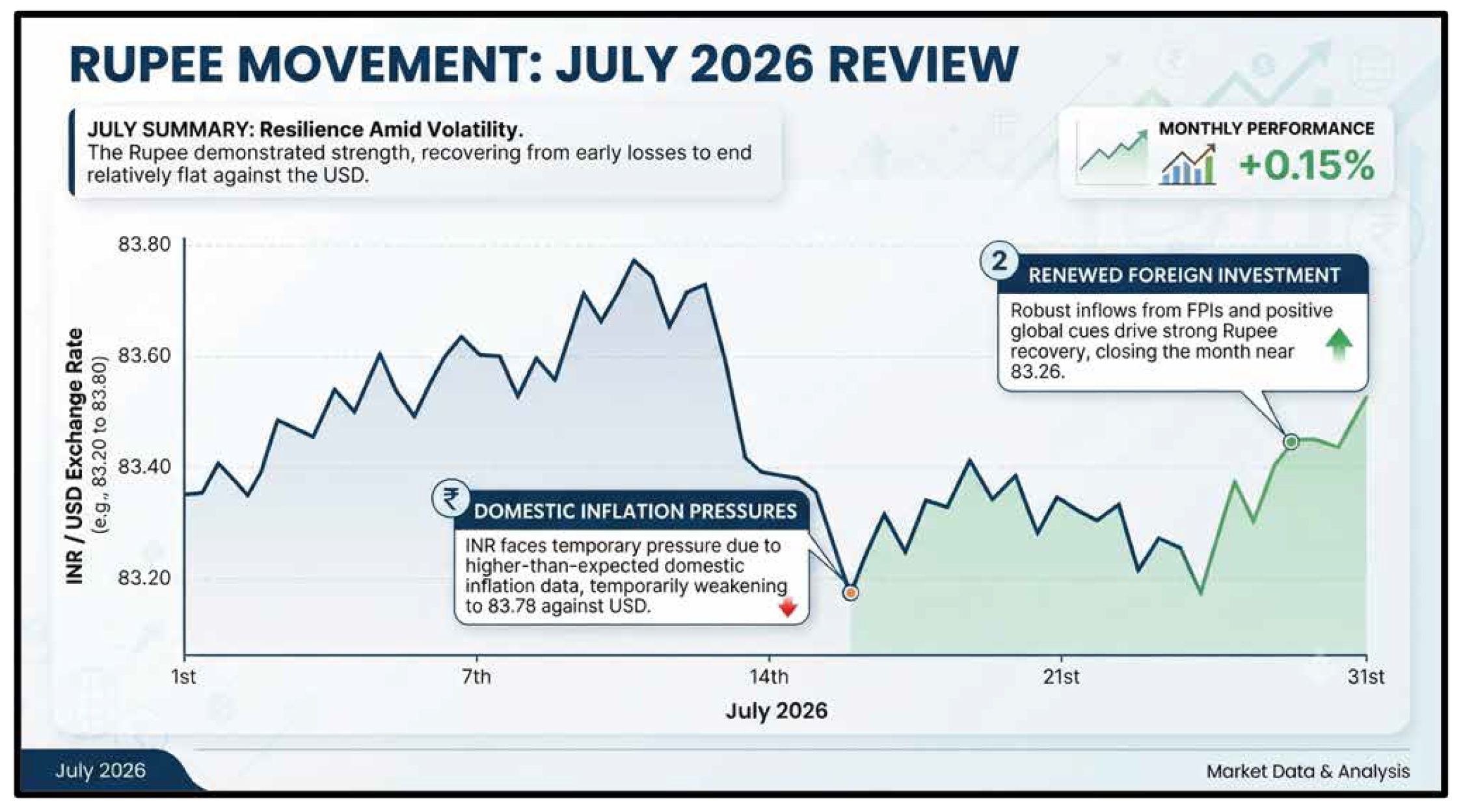
The Indian rupee remained under pressure throughout July 2026, trading within a relatively narrow 95.0–96.0 per US dollar range but experiencing intermittent bouts of weakness driven by external factors. Although the currency briefly approached its record low of 96.88 per dollar during the month, it recovered to close at around 95.35–95.37 per dollar, ending July modestly firmer than its weakest levels but still historically weak. Compared with the sharp depreciation witnessed earlier in 2026, July represented a period of relative stability, though the rupee remained vulnerable to global developments and persistent dollar strength. The principal source of pressure was renewed geopolitical tension in West Asia, which pushed Brent crude oil prices close to $90 per barrel at times. As India is heavily dependent on imported crude, rising oil prices widened concerns over the country's trade deficit, inflation, and current account balance, weighing on the currency. These pressures were compounded by a strong US dollar, supported by the US Federal Reserve's hawkish policy stance and expectations that interest rates would remain elevated for longer. Higher US yields encouraged global investors to favour dollar assets, limiting the appeal of emerging market currencies, including the rupee. Despite these headwinds, the rupee avoided a sharper depreciation largely due to decisive intervention by the Reserve Bank of India (RBI). Around July 25, when the currency neared its record low, the RBI reportedly sold nearly US$7 billion in the foreign exchange market—one of its largest interventions in recent months—and continued supporting the rupee through additional dollar sales and liquidity management measures. Investor confidence was also strengthened by recent capital-account reforms, including the expansion of the Fully Accessible Route (FAR) for government securities and tax incentives for foreign investors, which encouraged sustained foreign investment into Indian debt markets. Additionally, foreign portfolio investors returned as net buyers of Indian equities during July, providing further support to the rupee. Overall, July reflected a fragile balance in which external pressures from higher oil prices and a stronger dollar were largely offset by RBI intervention, healthy foreign capital inflows, and India's comfortable foreign exchange reserves, allowing the currency to stabilise despite persistent global uncertainty.
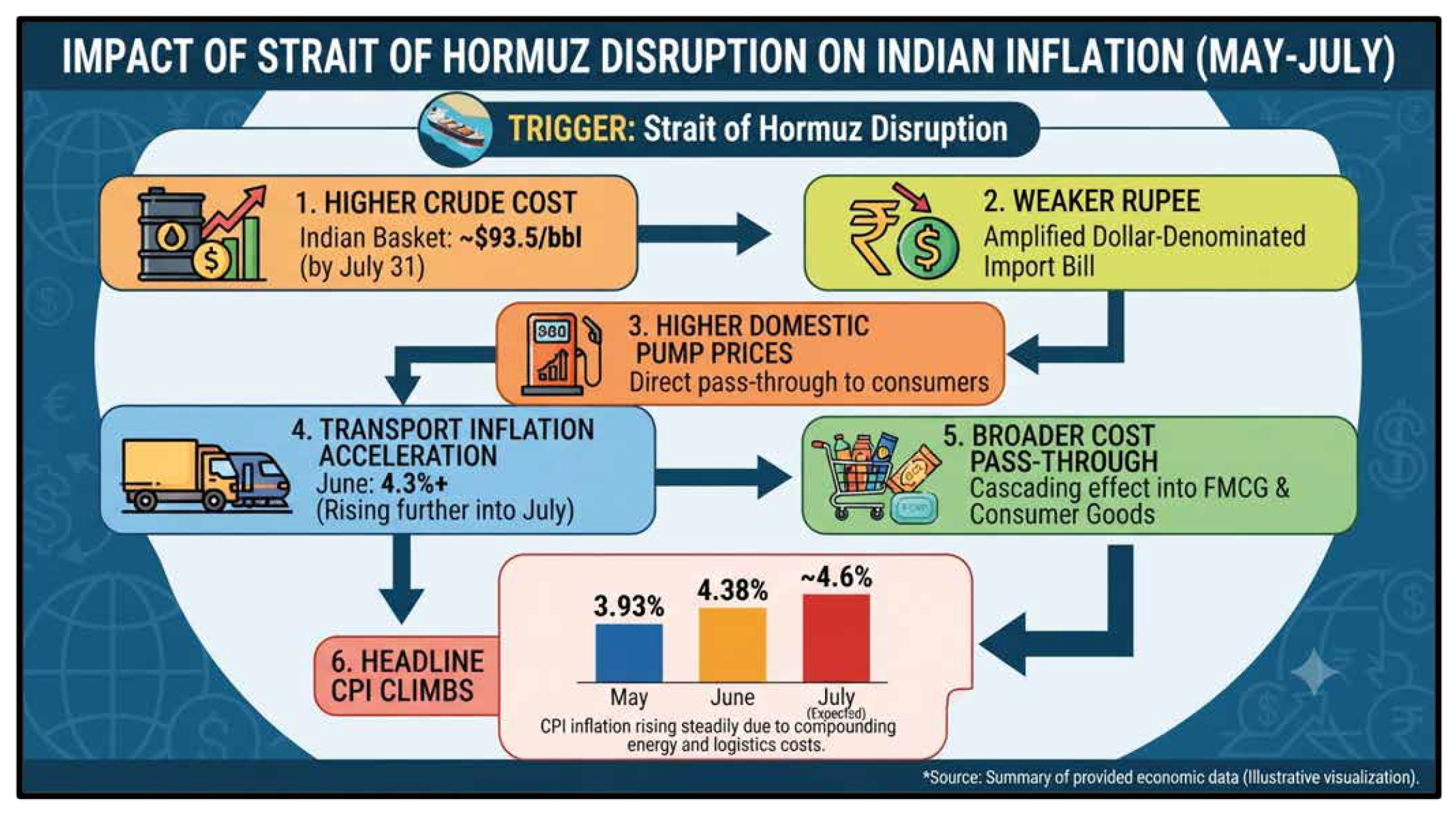
Crude oil markets experienced a dramatic turnaround in July 2026, with prices rising sharply after beginning the month at multi-month lows. Brent crude started July below $70 per barrel, reflecting easing supply concerns following the June ceasefire in West Asia, but sentiment changed rapidly as renewed geopolitical tensions triggered a powerful rally. By mid-July, escalating military action between the US and Iran, attacks on commercial vessels, and repeated threats to disrupt shipping through the Strait of Hormuz pushed Brent crude above $85 per barrel. The rally intensified in the final week of the month, with Brent ending July near $88 per barrel, recording a monthly gain of roughly 18–24%, its strongest rise since March 2026. The resurgence in crude prices was driven primarily by fears of supply disruptions rather than changes in underlying demand. The renewed US-Iran conflict, attacks on oil tankers, and uncertainty surrounding one of the world's most important energy transit routes significantly increased the geopolitical risk premium in oil prices. Falling US crude inventories further tightened market sentiment, while concerns over slowing global demand that had weighed on prices earlier in the month were overshadowed by escalating supply risks. Although alternative shipping routes through the Red Sea gradually reduced fears of a complete disruption to global oil flows and OPEC+ maintained plans to increase production from August, these factors only moderated, rather than reversed, the rally toward month-end. For India, the sharp increase in crude oil prices posed significant macroeconomic challenges. As the country imports nearly 85% of its crude oil requirements, higher international prices translated into rising fuel and transportation costs, putting upward pressure on inflation. The impact was amplified by a weaker rupee, which increased the local currency cost of oil imports. Higher logistics and input costs also raised concerns about broader inflation through food, manufacturing, and consumer goods. Inflation expectations consequently strengthened, with analysts anticipating headline CPI to rise further after June's increase to 4.38%, while the Reserve Bank of India maintained a cautious stance on monetary policy. Overall, July highlighted how geopolitical developments in West Asia quickly transmitted into India's economy through higher energy costs, reinforcing crude oil's role as the primary channel of imported inflation during the month.
India’s insurance sector in July 2026 was marked by significant regulatory activity, new insurer approvals, and improving business momentum. IRDAI focused on strengthening governance and customer protection, with proposed reforms around distributor commissions aimed at reducing mis-selling by shifting incentives toward a life-of-policy payout model. The regulator also tightened oversight through penalties for guideline violations, enhanced intermediary norms, AI governance initiatives, and revised rules on investments, ownership, mergers, and capital structures. On the business front, life insurers reported strong premium growth momentum in Q1 FY27, led by private players, while the non-life segment showed recovery driven by health and motor insurance. July also saw key licensing developments, including approval for a new general insurer, ProTec General Insurance. Overall, the month reflected a balance of regulatory tightening and improving industry fundamentals, with IRDAI driving reforms across distribution, governance, and market expansion.