
Topic 1: EQUITY: AWAKENING
July 2026 was another positive month for Indian equity markets, with both the BSE Sensex and NSE Nifty 50 extending their gains despite experiencing considerable volatility. The month was characterized by a sharp correction during the first half, followed by a strong recovery in the latter weeks, allowing both benchmark indices to finish higher. The Nifty 50 ended the month at 24,383.60, gaining approximately 2.2%, while the Sensex closed at 78,094.64, up around 2.1%, after briefly touching an intraday high of 78,664.92. This marked the first consecutive monthly gain for both indices in 2026 and reinforced the resilience of Indian equities despite persistent geopolitical tensions, fluctuating crude oil prices, and uncertain global economic conditions. During the month, the total market capitalization of BSE-listed companies increased by nearly ₹12 trillion, reaching approximately ₹486 trillion, while Indian markets outperformed most major Asian indices as well as the S&P 500 and Nasdaq.
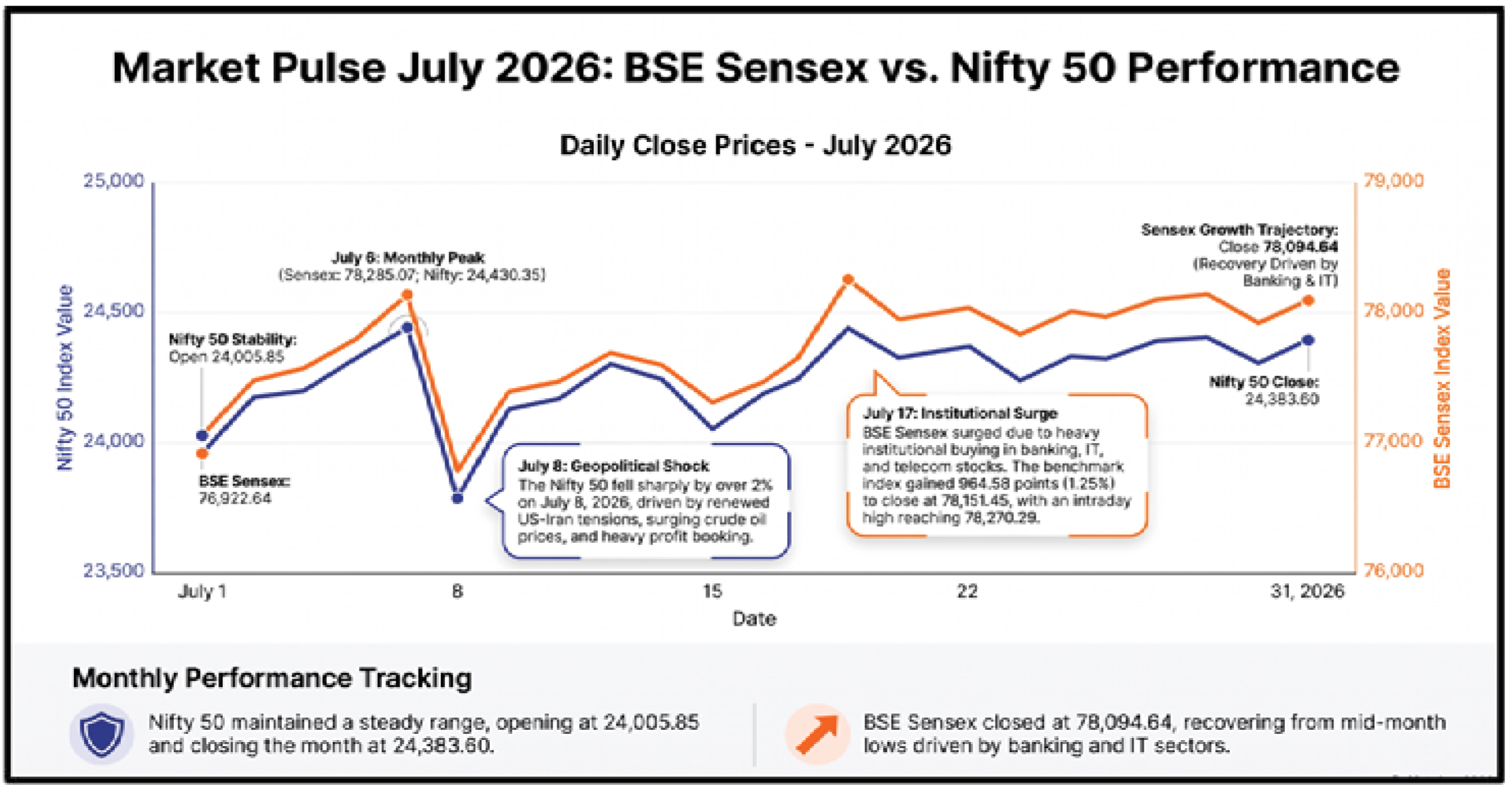
The journey to these gains, however, was far from smooth. The month began on a relatively stable note, with the Nifty closing the week ending July 3 at 24,270.85. Sentiment deteriorated rapidly over the following days as investors turned cautious amid escalating geopolitical tensions in the Middle East, rising crude oil prices, and increased global market volatility. The Nifty declined sharply to around 23,882 by July 8, while the Sensex also registered a steep fall, reflecting widespread profit booking after the previous rally. Concerns over persistent inflation, uncertainty regarding global interest rates, and foreign institutional investor (FII) selling added further pressure. The situation intensified between July 6 and July 13 as renewed attacks on shipping routes, military strikes involving Iran, and missile exchanges increased fears of disruptions to global oil supplies. On July 13, the Sensex recorded one of its sharpest intraday declines of the month, falling more than 700 points as investors reacted to heightened geopolitical risks. As the month progressed, market sentiment gradually improved despite the conflict remaining unresolved. Investors became increasingly accustomed to geopolitical headlines, shifting their focus toward corporate earnings and domestic economic fundamentals. Better-than-expected quarterly results from several large companies, particularly private sector banks and leading information technology firms, encouraged investors to return to equities. Strong earnings reaffirmed confidence in corporate profitability and supported buying during market declines. Financial stocks, automobiles, and several heavyweight companies led the rebound, while selective IT companies delivered encouraging earnings that revived interest in the technology sector. Although a few large corporations issued cautious guidance that occasionally triggered intraday volatility, the overall earnings season remained sufficiently positive to improve investor confidence. Foreign investor activity played a decisive role in the market's recovery. After remaining net sellers for several consecutive months, foreign portfolio investors (FPIs) returned as net buyers during July, investing over ₹15,000 crore, with some estimates placing total inflows above ₹20,000 crore when primary market investments were included. This reversal marked a significant change after substantial outflows recorded between March and June and reflected improving confidence in India's economic outlook relative to other emerging markets. The return of foreign capital provided liquidity to large-cap stocks and helped offset concerns arising from global uncertainty. At the same time, strong domestic participation through systematic investment plans (SIPs), sustained retail investor interest, and continued inflows into mutual funds provided an additional cushion whenever markets corrected. The information technology sector emerged as the month's standout performer. A global sell-off in artificial intelligence-related stocks prompted international investors to rotate capital toward relatively stable Indian IT companies, resulting in a remarkable rally. The Nifty IT index surged nearly 17%, recording its strongest monthly performance since July 2020. The rally was further supported after the US Federal Reserve kept interest rates unchanged at its July policy meeting, easing concerns about tighter global financial conditions and encouraging continued investment into export-oriented technology companies. Apart from IT, several domestic sectors also posted healthy gains. Consumer durables, real estate, and automobile stocks benefited from expectations of improving consumer demand, lower input costs as crude oil softened later in the month, and optimism surrounding the broader economic outlook. Macroeconomic developments continued to influence investor sentiment throughout July. Rising crude oil prices during periods of heightened Middle East tensions weighed on markets because India remains heavily dependent on imported energy, making higher oil prices a risk for inflation, corporate margins, and the fiscal balance. Brent crude experienced sharp swings, at one point climbing close to $88 per barrel amid renewed conflict before easing later in the month. The subsequent moderation in crude prices reduced inflation concerns and supported the market recovery. Investors also monitored domestic inflation data and wholesale price trends closely, as these influenced expectations regarding the Reserve Bank of India's future monetary policy decisions and bond yields. A relatively stable rupee, combined with softer commodity prices toward the end of the month, further strengthened investor confidence. Although benchmark indices recorded healthy monthly gains, the underlying market breadth remained relatively narrow. Large-cap stocks, particularly within the IT sector, accounted for a significant share of the rally, while many mid- and small-cap stocks struggled to keep pace. The Nifty 50, Nifty Midcap 100, Nifty Smallcap 100, and Nifty 500 indices all posted gains ranging between roughly 1.5% and 2%, demonstrating broad resilience across market segments. However, on the BSE, while the Sensex, BSE 500, and Midcap indices advanced, the Smallcap index ended marginally lower. More than half of the BSE 500 constituents underperformed the benchmark, and nearly 280 stocks declined during the month, highlighting that investor participation remained concentrated in select large-cap companies rather than being uniformly distributed across the market. Overall, July 2026 demonstrated the resilience of Indian equity markets in navigating multiple external and domestic challenges. Despite geopolitical conflicts, volatile crude oil prices, inflation concerns, and periods of foreign selling, markets recovered strongly on the back of robust corporate earnings, renewed foreign investment, resilient domestic liquidity, and improving global risk appetite. The strong performance of the IT sector, combined with healthy participation from financials and consumer-focused sectors, helped Indian benchmarks outperform several global peers. By the end of the month, investors had largely looked beyond short-term geopolitical disruptions and refocused on India's long-term growth prospects, enabling both the Sensex and Nifty to record another month of positive returns while reinforcing confidence in the market's underlying strength.